
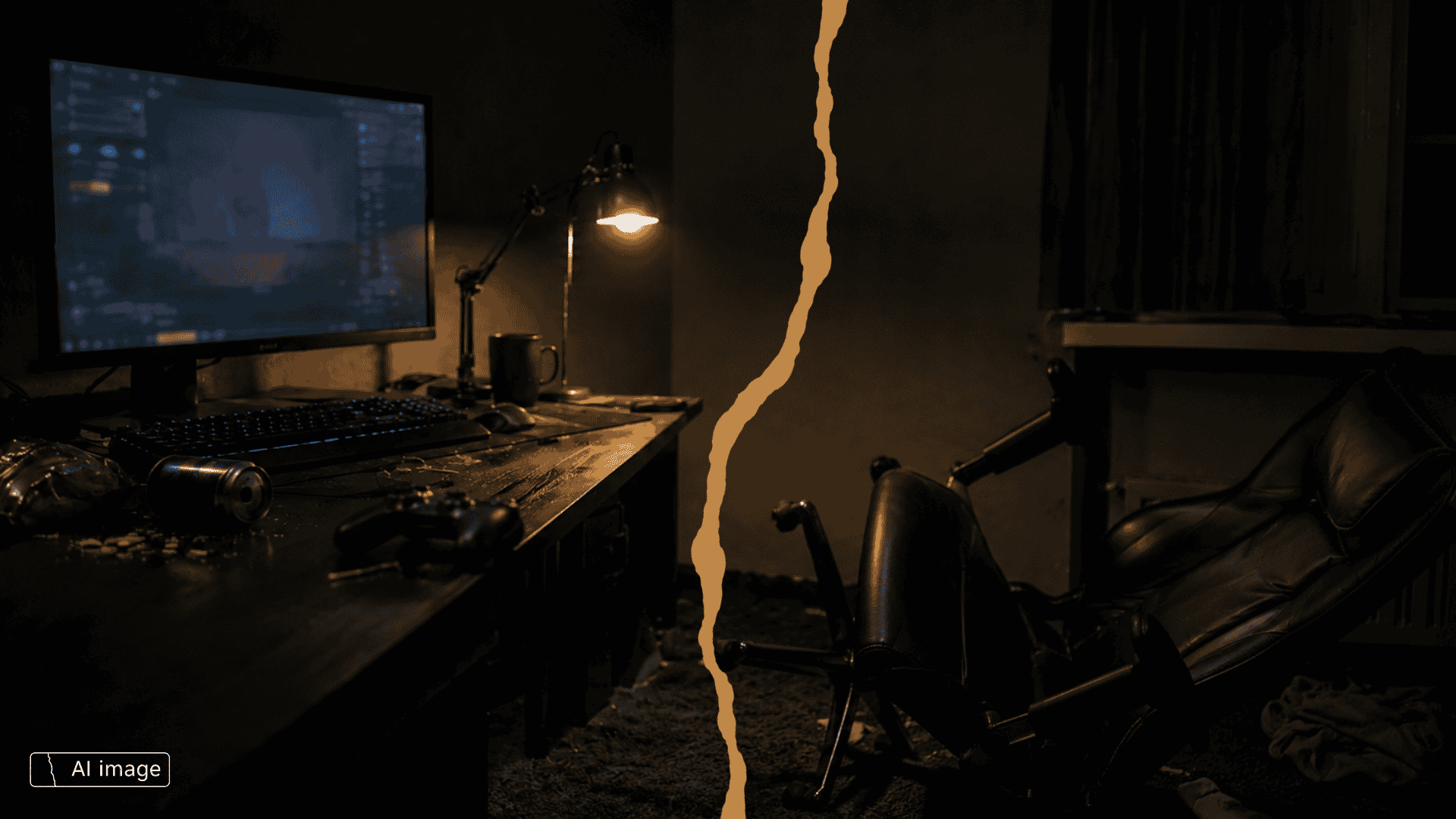
A few months after devcom 2025, the Trust & Safety panels still echo. And yet scenes like this keep happening:
Two teams meet in a snow-covered valley in an online shooter. Trash talk starts flying: "Nice try, noob!" Half teasing, half territorial. Minutes later the server-wide chat is full of insults, threats, and personal attacks.
The mood in voice chat spirals upward. Nobody is playing tactically anymore. The only goal: blind destruction and humiliating the other side. Even when both teams know they'll never recover their losses.
What started as fun becomes frustration, and an engaging match ends in toxic deadlock.
When Teasing Escalates: From a Comment to a Spiral
Moments like these make something clear. A multiplayer game can be technically brilliant and still be no fun to play. One foundation of enjoyment isn't polygons or frame rates; it's the communities. They decide whether you log off after a match with a satisfied "GG! Thanks for the raid!" or uninstall in frustration.
This isn't just a gut feeling. A study by the Anti-Defamation League (ADL) found that 75% of players aged 10 to 17 reported experiencing harassment in gaming in 2023 [1]. For many, toxic behavior is simply part of the routine.
The psychological consequences are measurable: depression, problematic gaming patterns, and heightened anger responses, all documented among those who experience harassment repeatedly.
A gender dimension runs through almost every study. Men report encountering toxic behavior more often in absolute terms. Women, however, are disproportionately targeted by deliberate, identity-based harassment and more frequently respond by withdrawing from the game entirely [1][2].
Why a Few Players Can Ruin Things for Many: Data and Psychology
The loud minority. The group causing problems is small. According to Riot Games, only about 5% of players are persistently problematic. But the other 95%, regular players who occasionally lose their composure mid-match, account for 86% of all reports [3]. The issue isn't just a small core of repeat offenders. It's the cumulative weight of moments when ordinary players snap. Other speakers at devcom cited similar figures for the persistent core: 3 to 5% of players are consistently disruptive and disproportionately shape the experience for everyone else.
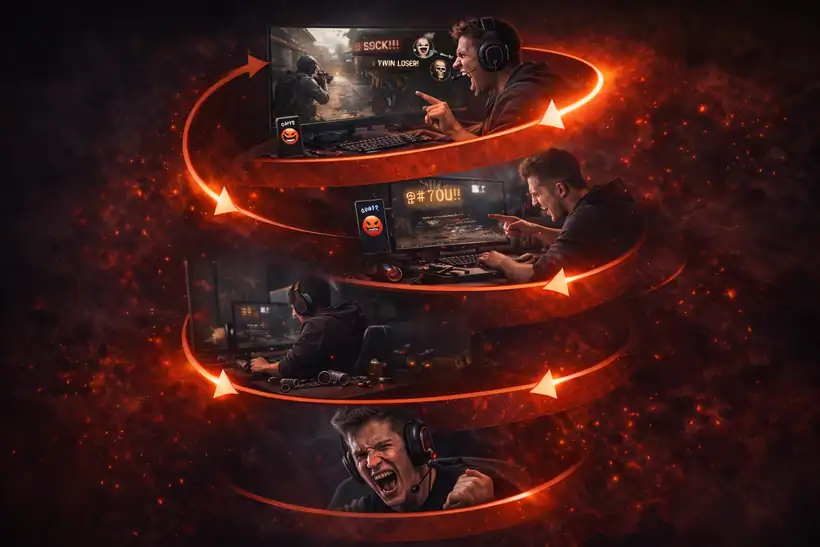
The negative domino effect. Toxicity spreads. Players who are targeted tend to retaliate in kind, setting off a chain reaction [4]. A few toxic comments poison entire matches. In extreme cases, the whole server watches it play out in the public chat.
The spiral of silence. Psychologically, a well-known dynamic amplifies this further. Those under attack withdraw. The loudest voices set the tone. Even players not directly targeted start experiencing the match as negative.
One example from League of Legends, where toxic behavior is directed at one's own team: a single AFK player is enough. Someone stops actively participating mid-round. What remains is a 4‑versus‑5 match, which means less map control, declining morale, and usually a loss for the smaller group.
The tone often escalates from there. Instead of sticking together, the remaining players look for someone to blame. An ideal environment for insults. And the in-game chat documents that negative experience far longer than any highlight of genuine teamwork stays in memory.
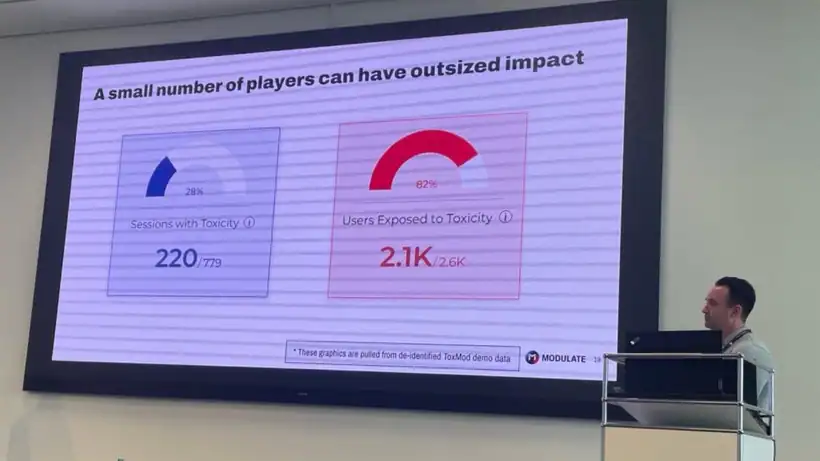
The reach is significant. A small number of players influences larger groups, even when only a few are directly involved in any given situation. At devcom 2025, Mark Frumkin (Modulate) and Grant Cahill (Activision) reported on testing the software ToxMod in the Call of Duty community. Their finding:
"A small number of players can have outsized impact." Mark Frumkin (Modulate) & Grant Cahill (Activision), devcom 2025

Not every escalation is as clear-cut as going AFK in LoL or hate speech in Battlefield 6, though. Between harmless teasing and deliberate targeting lies a gray zone. What some call trash talk, others experience as toxic. Where is that invisible line?
Banter vs. Toxic: How to Read Trash Talk in Gaming
Banter operates on equal footing. Online gaming runs on commentary. "Get rekt!", "EZ game", or mocking laughter in voice chat are, for many players, part of what makes competitive matches enjoyable. Banter is a playful test of strength. It marks territory, signals confidence, and can be motivating.
By definition: banter consists of short, pointed comments, usually not meant seriously, and often culturally accepted. Examples: "Nice try, noob!" after a lost fight, or an ironic "Easy!" at the end of a match.
Toxic behavior is something different. It describes communication that repeatedly or deliberately causes harm. People are put down, excluded, or harassed. The defining feature is intent: to humiliate or frustrate others (cf. [5]).
Rachel Kowert's subcategories of toxic behavior [5]:
- Verbal abuse: insults, hate speech, sexist or racist language, threats.
- Griefing: using the game in ways it wasn't designed for; this can target opponents or teammates, up to and including deliberate sabotage of one's own team.
- Spamming and flaming: aggressive flooding of the chat.
- Harassment and stalking: sustained, targeted attacks on the same person or group across matches, platforms, or sessions.
- Cheating and exploiting: not verbal, but often experienced by the community as toxic because it breaks fair play.
Perception varies widely. A study on Valorant from Hochschule Offenburg found that 80% of matches involved insults [6]. Some players experience this as normal trash talk; others leave the game because of it. Identity-based insults in particular, as noted earlier under verbal abuse, carry a strongly negative impact. According to the ADL, roughly 37% of young players reported such experiences in 2023 [1].
Culture and Context: Where Trash Talk Lands Differently
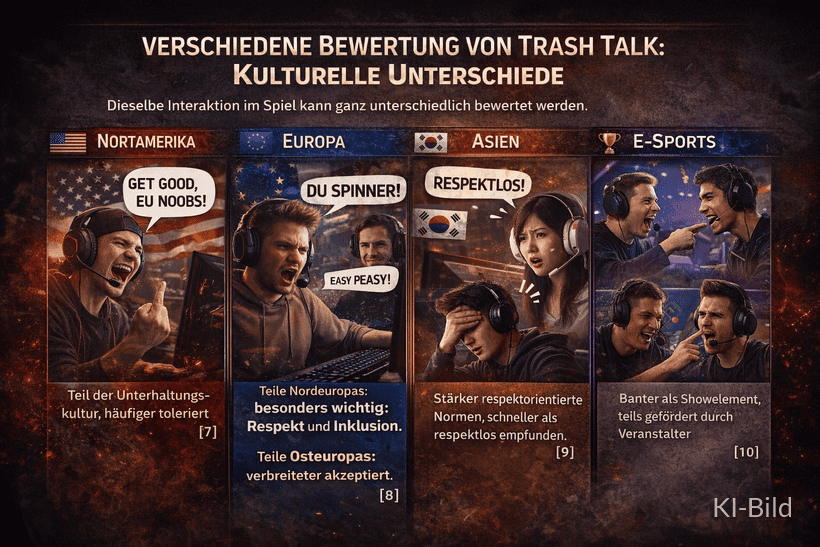
One reason for the range in how trash talk is perceived is cultural context. The same interaction can be evaluated in very different ways:
- North America: trash talk is often part of entertainment culture and more widely tolerated [7].
- Europe: "EU Kids Online" [8] shows more sensitivity overall; respect and inclusion are particularly valued in Northern Europe, while trash talk is more common and accepted in parts of Eastern Europe.
- Asia: norms tend to be more respect-oriented. In South Korean or Japanese communities, the same words are often perceived as disrespectful more quickly.
- Esports: banter as a performance element, sometimes actively encouraged by organizers [10].
- Casual gaming: without a show context, the same comment is more likely to be experienced as intrusive.
The invisible line. Banter depends on mutual agreement. Toxicity begins when that's missing, or when comments target vulnerabilities, identity, or repeated humiliation.
This gray zone is a challenge for developers and community managers alike, including those running hobby servers. Rules that are too vague, or inconsistently enforced, leave players feeling unprotected. Rules enforced too rigidly generate the feeling of being over-controlled.
Moderation in Transition: Report Systems vs. AI Voice Moderation
"I only play on moderated servers, so I'm protected." That's true when the moderation is good. On a well-run server, you can report misconduct and someone responds quickly. In unjustified cases, you might even get back what you lost, and the person responsible is confronted with their behavior and faces consequences.
The limits of traditional report systems
Report systems are reactive. By the time a report is filed, the damage is already done.
They get misused. Reports are sometimes filed out of frustration, for example when a player can't accept that their opponent simply played better.
They lack transparency. The process often feels opaque. It's rarely clear whether or how a report was acted on. Only some development teams and community servers make the consequences visible and provide feedback. Rust, for instance, notifies players when a report has led to a ban. But often that notification arrives weeks after the fact.
There's a practical problem too. Filing a report in the middle of a match means opening a menu, switching to the community Discord, filling out a form, and possibly uploading a clip. You lose time in-game, hurt your team during an active match, or wait until afterward and have to reconstruct exactly what happened and when.
Almost every report system eventually interrupts the game. Forms instead of flow. That gets in the way of the deeper immersion the game is trying to create.
Proactive Systems: What's Happening in the Market?
Bad-word filters came first. More and more studios are now moving toward preventive approaches.
Valorant is an example. Since 2022, AI-supported voice moderation has been analyzing in-game voice chat and flagging toxic language. Problematic speech is identified close to the moment it occurs, sequences are logged, and players under attack don't have to file a report mid-match. Violations become easier to track [11].
As discussed at the Community Clubhouse sessions at devcom 2024 and 2025, studios are increasingly investing in proactive automated detection. Ubisoft and Riot Games have addressed this with Zero Harm in Comms and the software ToxBuster [12]. Since 2022, they have combined anonymized chat data across the industry to train AI systems that generate preventive responses to harmful player interactions.
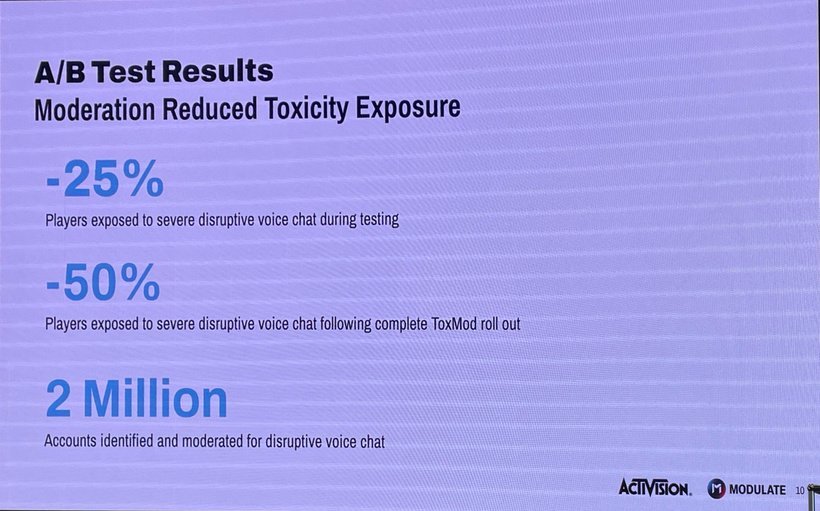
Mark Frumkin (Modulate) and Grant Cahill (Activision) presented comparable work in 2025 on ToxMod, used in Call of Duty moderation and tested via A/B comparison [13]. Their results showed that in matches with automated voice moderation active, significantly fewer players were exposed to toxic or disruptive behavior.
How Responses to Toxic Behavior Are Changing
From the ban hammer to something more educational. Early multiplayer moderation was blunt. Players who misbehaved got kicked, temporarily or permanently, for violating community standards.
Prisoner's Island. An alternative approach was to group players flagged for toxic behavior into matches together, and pit those teams against each other. The result was what came to be called the Prisoner's Island problem: both in terms of toxicity and cheating, affected players found themselves surrounded by others who could teach them a lot of bad habits. After the ban period ended or with a new account, they returned more practiced at bending the rules without technically breaking them, or with contacts for illegal software.
That said, a version of this approach appears to be in active use in a more refined form in Arc Raiders by Embark Studios (in Early Access since October 2025). The developers describe it as "aggression-based matchmaking," though the intent is not a simple binary classification of players as aggressive or non-aggressive. The system appears considerably more nuanced and still being calibrated [14].
Other approaches studios are testing:
Nudging instead of escalation. Small prompts before sending an aggressive message, "Are you sure you want to send this?", have been shown to measurably reduce the volume of sharp messages, according to devcom speakers [15].
Rewards, not just punishments. Rainbow Six Siege has a reputation system where positive behavior can be reported and recognized. The message: cooperation pays off.
Between technology and game feel. Moderation needs to work without destroying the experience. Invisible in the background, felt in its effects. Trust builds when systems work and feel fair.
Trust & Safety in Game Design: Transparency, Immersion, Effectiveness
More than punishment. A fair environment matters as much as good game balance. Without trust, the impression takes hold that anything goes. That drives away new and less experienced players in particular. Conversely, simply feeling that moderation systems are working is often enough to keep people playing longer.
Transparency over black boxes. Uncertainty erodes trust. League of Legends and Overwatch notify players after successful reports: "A player you reported has been punished." That single piece of feedback strengthens both trust and the willingness to report [16].
Invisible safety nets. Moderation shouldn't cut through immersion. The skill is working in the background without disrupting the flow of play. Credible effectiveness matters more than constant visibility.
A design question, not just a support issue. Trust and Safety belongs in game design. Players don't only evaluate graphics, balance, or story. They evaluate the social experience. Designing for trust actively, through transparent processes, understandable consequences, and fair mechanics, builds long-term engagement.
Community Design: Players as Co-Creators
From feedback loops to genuine participation. Early Access, open betas, forums: players are increasingly becoming co-developers. They provide feedback, test features, and have a say in decisions. Minecraft, Valheim, and Baldur's Gate 3 show how this accelerates development and raises quality.
Reinforcing positive behavior. Thank-you messages. Badges. Rewards for teamwork or creative contributions. Fortnite Creative turns players into designers. Officially featured maps send a signal: you are part of this game.
Belonging as a success factor. People stay longer when they feel heard and valued [17]. Moderation and participation belong together. Studios that only control lose out. Those that open spaces build loyal communities.
Rust Community Servers: A Practical Example
Rust shows how powerfully communities shape a game. The base game is a harsh survival sandbox. Variety emerges on community servers with their own rules, mods, and events. Some reward helpfulness with in-game resources or Discord shoutouts. Others encourage creative projects. These "games within the game" don't come from official design; they come from player engagement. The result: a harsh world becomes a creative playground.
The Cost of Toxic Communities
Toxic communities cost companies player retention and revenue. For private gaming server projects, the number of active players at minimum affects the motivation of the server team, and depending on how the community is structured, also the income it generates.
A few findings from the Unity Toxicity Report 2023:
67% of multiplayer players say they are likely to stop playing a game if they experience toxic behavior. 74% would not try a new game known for being toxic. Shooters are particularly affected [18].
What Remains: Banter Yes, Ban Hammer Only When Necessary
A match can flip from fun to frustration quickly. What determines the experience is how people treat each other. Studies and practice both point in the same direction: what secures long-term success isn't graphics or weapon balance; it's the community.
Toxic behavior usually comes from a small number of players, but its impact is disproportionate. The response is proactive: build trust, reward positive behavior, enable participation.
For players: banter is fine, as long as it stays mutual. For developers: the ban hammer is just one tool among several. The goal is a strong, healthy community that sustains the game.
Social design is no longer an add-on. It's the actual endgame, and we're all playing it.
Whoever takes communities seriously gains engagement, trust, and commercial success. Whoever ignores them loses, sometimes faster than a ragequit.
Transparency note: The original version of this piece was published in german on Patreon and has since been lightly revised and moved here.
Sources:
[1] ADL-Report, 2023
[2] Zsila, Á., Shabahang, R., Aruguete, M. S., & Orosz, G. (2022). Toxic behaviors in online multiplayer games: Prevalence, perception, risk factors of victimization, and psychological consequences. Aggressive Behavior, 48, 356-364.
[3] Riot Games, 2023
[4] Neto, Joaquim & Yokoyama, Kazuki & Becker, Karin. (2017). Studying toxic behavior influence and player chat in an online video game. 26-33. 10.1145/3106426.3106452.
[5] Kowert, R. (2020). "Dark Participation in Games." Frontiers in Psychology, 11,
[6] Görlich, D., Wagner, M., Breuer, M. (2025). Sexual Harassment in Valorant and Overwatch Voice Chats. In: Hartisch, M., Hsueh, CH., Schaeffer, J. (eds) Computers and Games. CG 2024, zitiert in polygon.com
[7] Kniffin KM, Palacio D. Trash-Talking and Trolling. Hum Nat. 2018 Sep;29(3):353-369.
[8] EU-Kids Online
[9] Source removed.
[10] Irwin, Sidney; Naweed, Anjum; Lastella, Antonio (2023). The AACTT of trash talk: Identifying forms of trash talk in esports using behavior specification. CQUniversity.
[11] Vice berichtet beispielsweise hierüber.
[12] Ubisoft beschreibt die Funktionsweise von ToxBuster hier
[13] Anti-Toxicity Report: Modern Warfare III results and Black Ops 6 launch
[14] ArcStatus - Zusammenstellung aller Dev-Statements zu aggression based matchmaking
[15] Wissenschasftlich erforscht ist das allerdings noch nicht sauber. Mijlstra, M., Rogers, K., Mandryk, R., Veltkam, R., Frommel, J. (2023): Help, My Game Is Toxic!
[16] Riot Games (2015): Instant Feedback Powers Up. https://www.leagueoflegends.com/en-us/news/dev/instant-feedback-powers-up/
[17] Baumeister, R. F. & Leary, M. R. (1995). The need to belong: Desire for interpersonal attachments as a fundamental human motivation. Psychological Bulletin, 117(3), 497-529.
[18] Unity: 2023 Toxicity in Multiplayer Games Report
3 thoughts on “Toxic Behavior in Online Games: What Actually Helps”
Comments are closed.